Translate
via Gemini AI
Source Text
0 / 1000
Translate To:

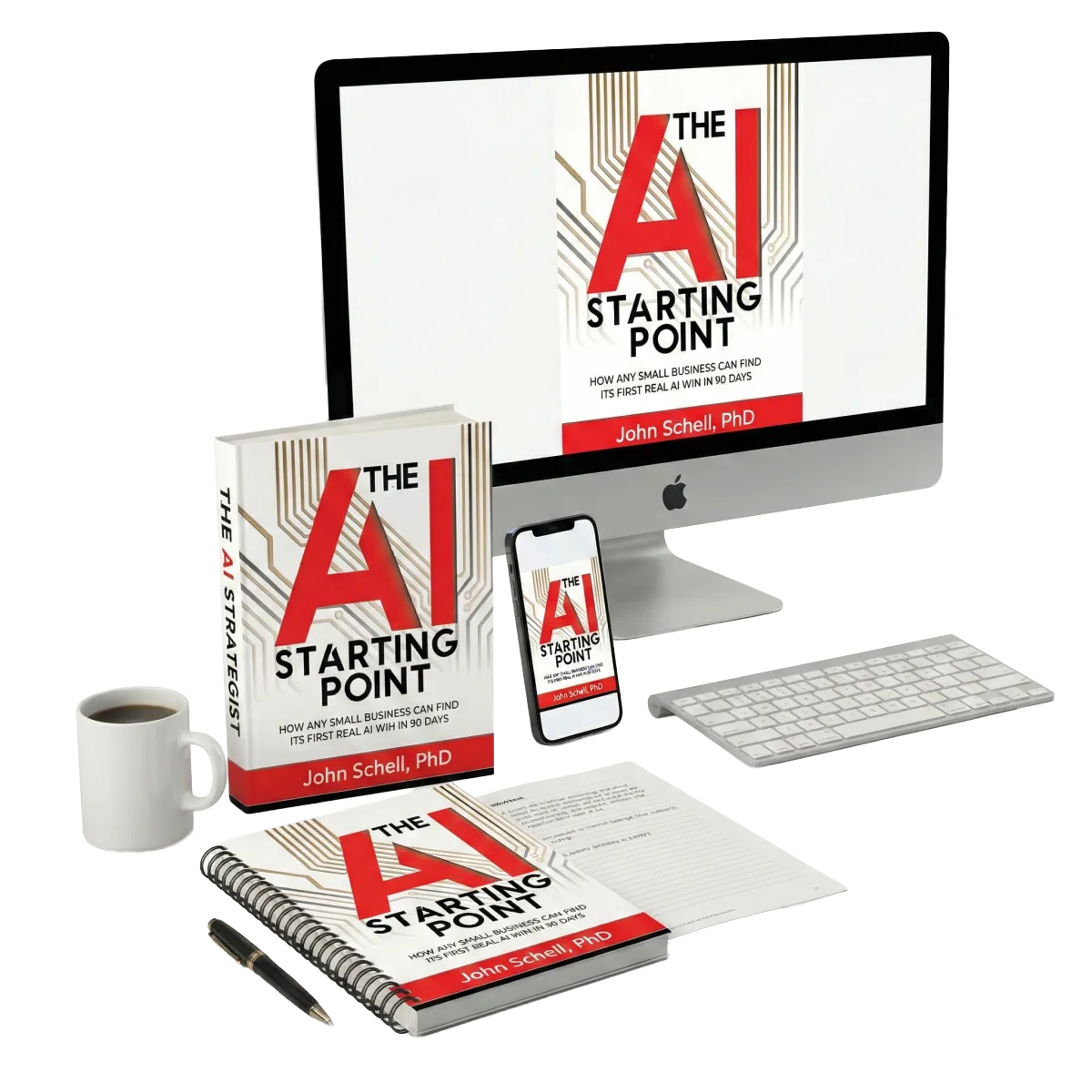
Most small business owners approach AI the wrong way.
They ask, "What AI tools should I use?" when the only question that actually matters is, "What problem am I trying to solve?"
The AI Starting Point is built on a simple but powerful premise: beneath all the jargon, hype, and complexity, AI does five things for a business.
It automates repetitive tasks (The Robot Arm). It creates content from scratch (The Blank Canvas). It understands and processes human language (The Universal Translator). It predicts future outcomes from historical data (The Crystal Ball). And it sees and interprets the visual world (The Watchful Eye). Your job isn't to master all five — it's to honestly identify your single biggest business bottleneck and match it to the tool built to solve it. Are you drowning in manual, repetitive work? That's a Robot Arm problem. Can't produce content fast enough? That's a Blank Canvas problem. Losing clients without warning? That's a Crystal Ball problem.
Most businesses only need one or two of these tools to fundamentally transform their operations.
The goal isn't to use more AI. It's to use the right AI — on the right problem — starting today.
If your team is staring at a blinking cursor more than they're creating, Generative AI — what The AI Starting Point calls "The Blank Canvas" — is the tool that changes everything.
Unlike AI that analyzes data or automates tasks, the Blank Canvas creates. It hands your team a first draft instead of a blank page — whether that's a blog post, a proposal, an email campaign, or a product description. It brainstorms taglines in minutes, repurposes a single whitepaper into a month of content, and compresses what used to take four to six hours into one or two.
The key insight most small business owners miss: it's not a replacement for your people. It's a replacement for the worst parts of their jobs — the drudgery, the research, the grinding climb from nothing to something — so your team can spend their energy on the work only humans can do.

Select a writing style, describe your product, and enter a topic to generate a publish-ready Facebook post.
If you built a business to give yourself freedom and it has slowly become your prison, Process Automation — what The AI Starting Point calls "The Robot Arm" — is the tool that breaks you out. Think of a robot arm on an assembly line: it performs the same motion, perfectly, thousands of times a day without getting tired, bored, or making mistakes. That's exactly what Process Automation does for your digital workflows. It moves data between your systems automatically, triggers follow-up emails the moment a lead goes cold, generates your daily sales report before you've had your first cup of coffee, and ensures every new customer gets the same seamless experience — without anyone on your team lifting a finger. The critical insight most small business owners miss: you don't need to automate everything at once. You need to automate one thing. The smallest, most painful step in your most broken process. Get that working. Then add the next step. That's where the transformation starts.
If your team is spending more time deciphering messages than doing their actual jobs, Natural Language Processing — what The AI Starting Point calls "The Universal Translator" — is the tool that restores order.
It's the bridge between the messy, unstructured world of human communication — your emails, your customer reviews, your supplier spec sheets, your support tickets — and the structured world of data your business can actually act on. It reads a 50-page report and hands you a one-page summary. It scans thousands of customer reviews overnight and tells you exactly what people love and hate. It answers common customer questions at 2 AM without waking anyone up. And for businesses operating across languages, it can eliminate the kind of miscommunication that once cost a decimal point and $40,000 in unusable materials.
The counterintuitive truth most business owners miss: the technology is only 40% of the solution. The other 60% is fixing the chaotic, freeform way your team communicates in the first place. You can't translate — or automate — a broken process.
Add some text, select a language, click the translate button, and see what happens.
This is not a commercial grade translator. But, it gives you an idea about possible tools for your business. Imagine your marketing running in multiple languages, your customer service responding in a customers native language, faster communication with overseas suppliers, or a review of product specifications written in another language.
If you've ever lost a client without warning — no "we need to talk" call, just a cold email saying they're gone — then you already understand why Predictive Analytics exists. It's what The AI Starting Point calls "The Crystal Ball": the AI tool that analyzes your historical data to find the patterns hiding in plain sight and forecast what's coming before it arrives. Which customers are quietly drifting toward the exit? Which leads are most likely to convert? How much inventory will you need next quarter? The Crystal Ball stops you from being a firefighter and makes you a strategist. But here's the truth most vendors won't tell you: the technology is the easy part. The real work — and the reason most first attempts produce garbage predictions — is your data. If your team logs information inconsistently, if your CRM is a mess, if "it depends who entered it" is the answer to any data quality question, no algorithm in the world will save you. The Crystal Ball is only as clear as the data you pour into it.
Drag the slider to raise or lower Elena's service pricing and watch how revenue and profit shift over six months. Small changes in price can have outsized effects on your bottom line.
Elena's digital marketing agency serves 42 retainer clients at a monthly rate of $8,500 per client. Her base cost to service each account is $5,400 — covering team salaries, tools, and overhead. That cost rises by 10% for each additional client she takes on, because scaling strains capacity. After cleaning her data, she wants to know: should she raise rates to improve margins, or offer discounts to win back churned clients?
If you've ever held a defective product in your hand and wondered how many more slipped through without anyone noticing, you already understand the problem that Computer Vision — what The AI Starting Point calls "The Watchful Eye" — was built to solve.
It's the tool that gives machines the sense of sight, allowing them to inspect every single unit on your production line, count every item in your warehouse, read every invoice that crosses your dock, and monitor your facility for safety risks — without ever getting tired, distracted, or bored. Unlike a human inspector who can only sample a fraction of what moves through your operation, the Watchful Eye sees everything, at superhuman speed and consistency.
The counterintuitive lesson most business owners learn the hard way: you don't need a six-figure "factory of the future" system to get started. One camera, one defect type, one production line — that's how Marcus Chen went from a 2% defect rate threatening his biggest client to less than 0.1%, with full ROI in under twelve months. Start small. Prove it works. Then scale.
Drag & drop an image here, or
Copyrights 2026 | The AI Starting Point™ | Terms & Conditions | Privacy Policy | Cookies Policy